

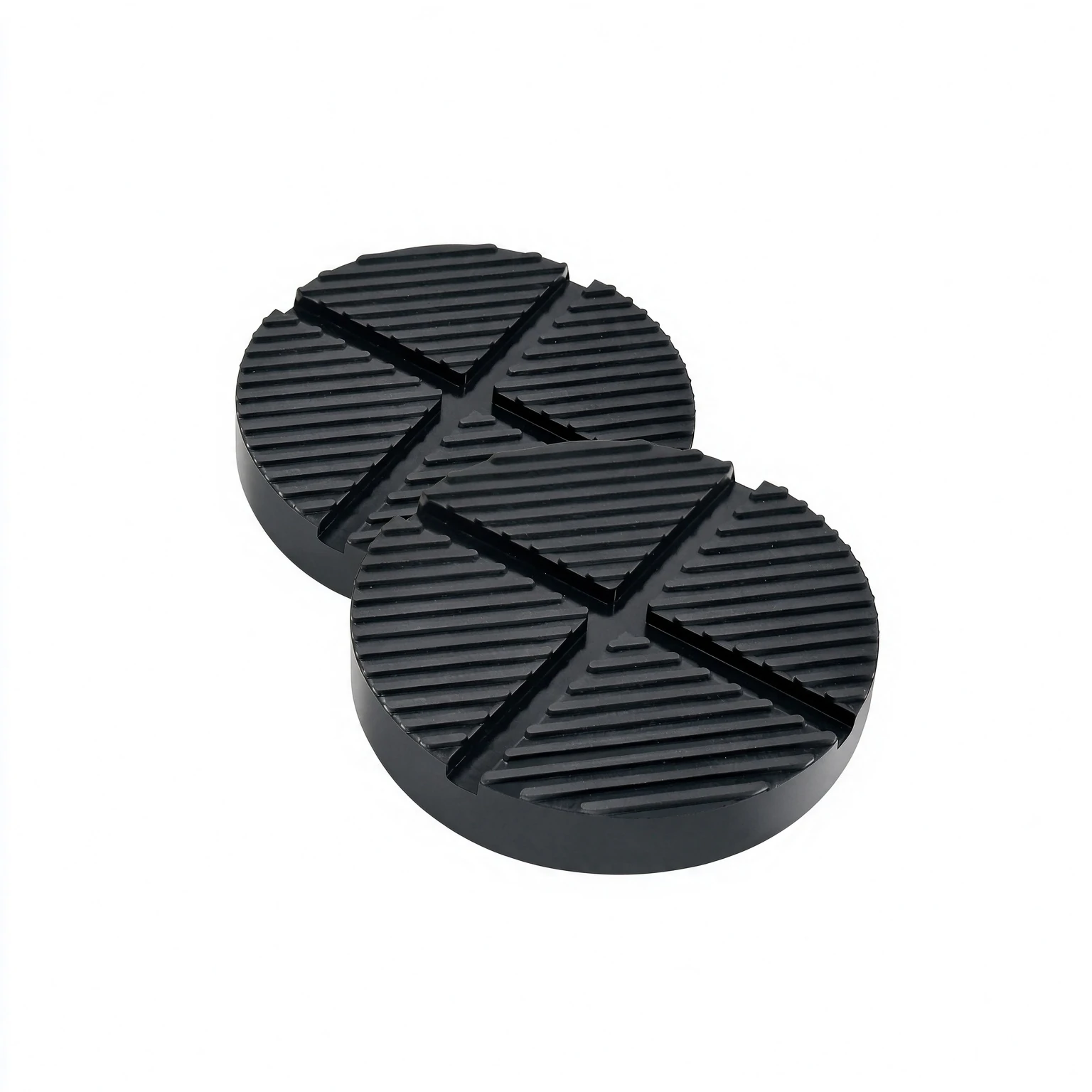
Rubber Jack Pad
Rubber Jack Pad Design and Function
The design of a rubber jack pad depends on the equipment and the intended contact interface.
A pad may be specified by its shape, thickness, contact surface, mounting details and material requirements. These factors influence how the component fits into the assembly and whether it matches the intended application.
When selecting a rubber jack pad, consider:
- Equipment type and model
- Contact surface dimensions
- Pad thickness and geometry
- Required material properties
- Mounting or retention arrangement
- Operating environment
- Load and contact conditions
- Replacement or new equipment requirements
A rubber pad should not be selected based on its overall appearance alone. The installation details and application requirements should also be reviewed.
Rubber Jack Pad Reference Chart
| Model Style | Diameter (mm) | Height (mm) | Slot Width (mm) | Max Load Capacity |
|---|---|---|---|---|
| Round Flat Puck | 50 | 20 | — | 2 Ton |
| Round Flat Puck | 60 | 25 | — | 2.5 Ton |
| Round Flat Puck | 65 | 30 | — | 3 Ton |
| Round Flat Puck | 80 | 30 | — | 4 Ton |
| Round Flat Puck | 100 | 35 | — | 5 Ton |
| Round Slotted Pinch Weld | 63 | 50 | 10 | 2 Ton |
| Round Slotted Pinch Weld | 80 | 60 | 12 | 3 Ton |
| Saddle Type Jack Pad | 136 | 18 | — | 3.5 Ton |
| Large Round Heavy Duty | 125 | 26 | — | 6 Ton |
Technical Notes
- Material: NR / SBR / EPDM rubber, hardness 70–85 Shore A; oil-resistant formula optional
- Features: Anti-slip, shock absorbing, prevents vehicle chassis and jack saddle damage
- Custom mould sizes are supported for 2-post lifts, floor jacks, truck hoists and jack stands
Product Configuration and Customization
Rubber jack pads may have different geometries depending on the equipment design.
| Configuration | Design Considerations |
|---|---|
| Flat Rubber Pad | Overall dimensions, thickness and contact surface |
| Shaped Rubber Pad | Profile, geometry and installation orientation |
| Molded Rubber Pad | Molded features and dimensional requirements |
| Custom Replacement Pad | Original dimensions, part number and equipment interface |
The final configuration should follow the application drawing or confirmed dimensions.
Hengjing can review custom rubber component enquiries based on the customer’s technical information. The feasibility of a specific jack pad depends on the required geometry, material and manufacturing conditions.
Material Selection for Rubber Jack Pads
The material should be selected according to the component’s function and operating conditions.
| Material | Common Selection Considerations | Important Checks |
|---|---|---|
| Natural Rubber | Elasticity and resilience in suitable applications | Loading, abrasion, temperature and chemical exposure |
| NBR Rubber | Certain oil- and lubricant-related environments | Exact fluid, temperature and compound compatibility |
| EPDM Rubber | Weathering, ozone and suitable water-related applications | Chemical exposure and temperature |
| Neoprene Rubber | Selected general industrial and outdoor applications | Medium, temperature and mechanical requirements |
Rubber Jack Pad Applications
Rubber jack pads may be used in equipment applications where the design requires a rubber contact, support or protective component.
Equipment Contact and Support Interfaces
A rubber pad may form part of a contact interface between equipment components. Its dimensions and material should match the intended installation and loading conditions.
Lifting and Maintenance Equipment
Certain lifting or maintenance equipment designs may use rubber pads at specific contact locations. The equipment manufacturer’s design and safety requirements should determine whether a rubber jack pad is appropriate.
Replacement Rubber Pads
Replacement pads may be needed when an original component becomes damaged, worn or unavailable.
For replacement enquiries, provide the equipment model, original part number, drawing, dimensions, photos and application details.
Important: A rubber jack pad should not be assumed to increase lifting capacity or make an unsuitable lifting arrangement safe. Load ratings, equipment compatibility and safety requirements must be established by the equipment manufacturer or responsible engineering authority.
Rubber Jack Pad vs. Other Rubber Pad Products
The name “rubber pad” can refer to different products. Their intended functions and design requirements may vary.
| Product | Main Distinction |
|---|---|
| Rubber Jack Pad | Designed for a specified jack or equipment contact application |
| General Rubber Pad | Used for a range of support, cushioning or protection functions |
| Rubber Washer | Typically a ring-shaped component used around a fastener or interface |
| Rubber Gasket | Designed to seal a joint between mating surfaces |
Hengjing also offers industrial Rubber Gaskets and custom Molded Rubber Parts.
Custom Rubber Jack Pad Manufacturing
For custom rubber jack pads, the purchaser should provide:
| Specification | Required Information |
|---|---|
| Part Dimensions | Length, width, diameter and thickness as applicable |
| Geometry | Profile, shape and molded features |
| Material | Material designation or required properties |
| Equipment | Equipment type, model and application |
| Contact Conditions | Intended interface and relevant loading conditions |
| Environment | Temperature, fluid exposure and outdoor conditions |
| Quantity | Prototype, replacement or production quantity |
| Inspection | Dimensional and other acceptance criteria |
Where a drawing is unavailable, measurements and photos may help establish the initial requirements. Critical dimensions and material specifications should be confirmed before production.
Technical Drawings and Reference Dimensions
A technical drawing should identify the dimensions required for the component to fit the intended equipment.
For a rubber jack pad, the drawing may include:
- Overall length and width or diameter
- Thickness
- Contact surface geometry
- Mounting features
- Relevant tolerances
- Material specification
- Part number or revision
A reference size chart should only be added after Hengjing confirms the actual available dimensions. Do not publish generic jack pad load ratings or dimensional ranges as Hengjing product specifications without supporting product data.
Quality and Inspection Requirements
The purchaser should identify any dimensional inspection, material verification or other acceptance requirements that apply to the jack pad.
For rubber materials, relevant test methods may include hardness, tensile properties or compression-related testing, depending on the material and product specification. These tests do not automatically establish a load rating or certify the product for a particular lifting application.
Any required standard, inspection record or material documentation should be specified during the quotation stage.
Request a Quote for Rubber Jack Pads
Send Hengjing the part drawing or dimensions, equipment details, material requirements and quantity.
Our team can review the available information and clarify the specifications required for your enquiry.
Frequently Asked Questions
What is a rubber jack pad?
A rubber jack pad is a rubber component designed for a specified support, contact or protective function in an equipment application. Its configuration depends on the equipment design.
Can rubber jack pads be customized?
Custom enquiries can be reviewed based on drawings, dimensions, material requirements and application conditions. Manufacturing feasibility depends on the specified component.
Which rubber material is suitable for a jack pad?
Material selection depends on the intended function, loading conditions, environment, temperature and media exposure. Natural rubber, NBR and EPDM may be considered for different applications, subject to compatibility.
Can a rubber jack pad be used with any jack or lifting equipment?
No. The pad must match the equipment design and manufacturer’s requirements. Compatibility and safety must be verified for the specific equipment.
What information is required for a rubber jack pad quotation?
Provide the equipment model, drawing or dimensions, material requirements, application details, quantity and any inspection requirements.
Can Hengjing provide replacement rubber jack pads?
Replacement enquiries can be reviewed using the original part number, dimensions, equipment information and photos. Critical specifications should be confirmed before ordering.